Role
UX/UI Designer
2016–2019
As one of the world’s leading luxury fashion marketplaces, Farfetch faced a unique challenge: delivering the highly curated, personal experience expected by luxury customers while operating at the scale of a global digital platform.
Serving more than 2 million customers across 190 countries, with access to over 500 brands and 700 boutiques, Farfetch was navigating a period of extraordinary growth, rapidly expanding its teams, capabilities and ambitions on its journey towards becoming a publicly traded company on the New York Stock Exchange.
Working across Loyalty, Personalisation, CRO and Checkout, my role focused on balancing customer expectations, commercial objectives and operational realities. The challenge was not simply to optimise individual journeys, but to maintain a seamless and premium end-to-end experience as the ecosystem became increasingly complex.
Every initiative required navigating the constant tension between exclusivity and accessibility, personalisation and scale, customer value and business performance, ensuring that growth never came at the expense of the luxury experience.

At Farfetch, launching a feature was never the end of the process, it was the beginning of the next learning cycle. Working alongside Product Managers, Engineers, Analysts and Researchers, I contributed across multiple areas of the product, developing a holistic understanding of the customer journey and the interconnected nature of marketplace experiences.
Experimentation was deeply embedded in the company’s culture. Every design change, optimisation and new feature was measured against clear business and customer outcomes. Rather than relying on assumptions or subjective opinions, we defined hypotheses, prioritised opportunities through behavioural insights and continuously validated solutions through A/B testing and test-and-learn methodologies. Every solution was viewed as an iteration, not a final answer.
One example of this mindset came from an initiative I led focused on optimising the Product Detail Page (PDP), one of the most commercially critical areas of the customer journey. Through customer research, behavioural analysis and experimentation, we identified an opportunity to improve the visibility of key conversion elements by repositioning them above the fold. While the design changes themselves were relatively small, the impact was significant: the initiative generated an estimated €13M in additional revenue within just three months.
The experience reinforced a lesson that became central to how I think about product design: meaningful business impact does not always come from large-scale redesigns. Often, it comes from identifying the right opportunities, understanding user behaviour and systematically validating improvements through experimentation.
Equally important was our direct access to customers. Through regular usability testing sessions with real users, we validated concepts, uncovered unmet needs and gained a deeper understanding of the motivations driving customer behaviour. Combining quantitative evidence with qualitative feedback allowed us to make more informed decisions and continuously refine the experience.
Experiencing Farfetch’s exponential growth first-hand reinforced another fundamental lesson: in high-performing organisations, design is never truly finished. As customer expectations evolve, markets change and new opportunities emerge, the role of design is to keep learning, adapting and improving, without ever standing still.
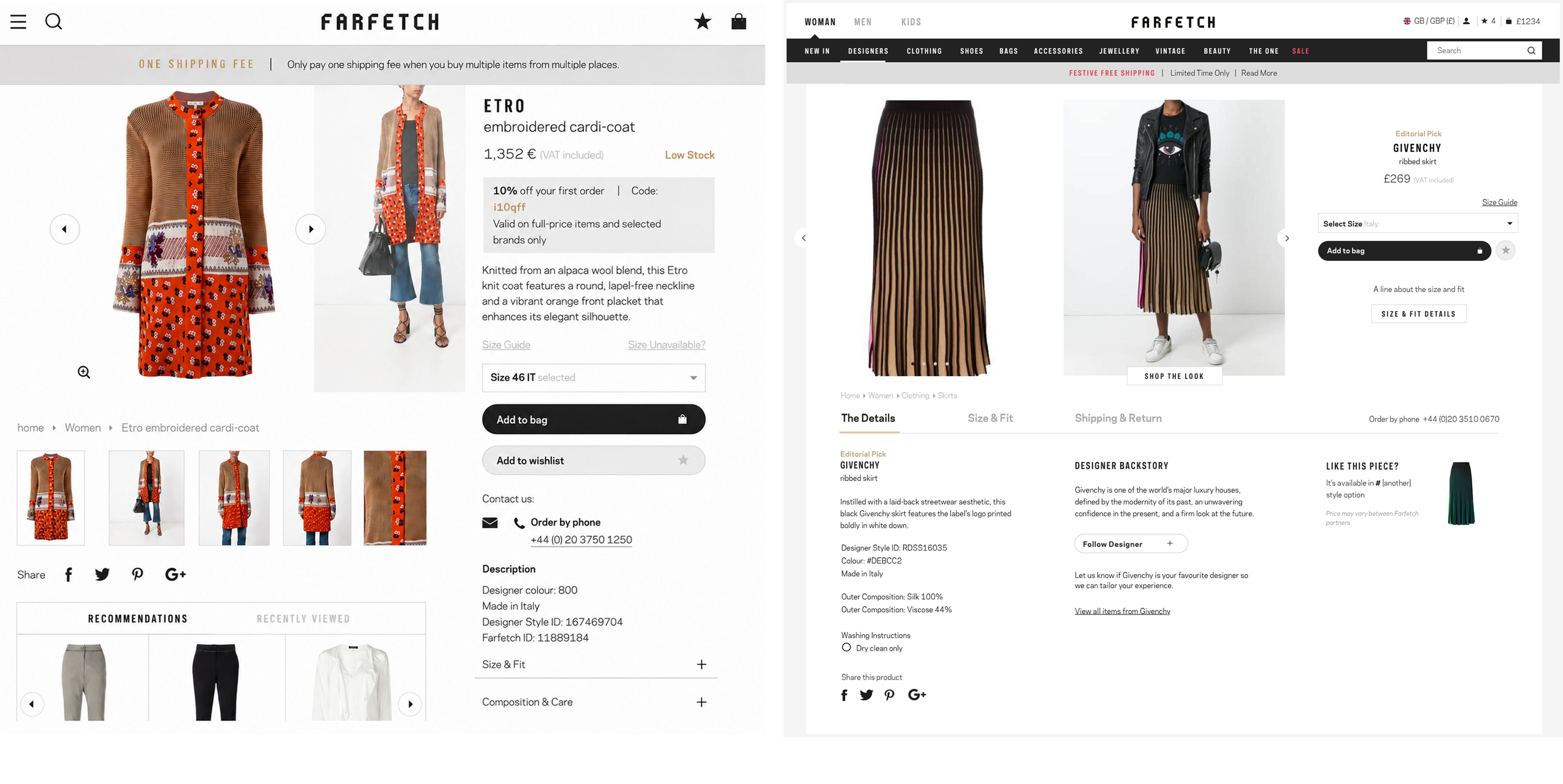
The experience reinforced the value of evidence-based design within large-scale digital products and hyper-growth environments.
More importantly, Farfetch shaped the way I think about design leadership: combining evidence, experimentation and deep customer understanding to make better decisions in environments where both speed and quality matter.
UX/UI Designer
2016–2019
Driving experimentation & optimisation across loyalty, personalisation, checkout and customer journey initiatives.
Contributed to measurable gains across customer experience and business performance.